


Building Social Capital Through Inclusive Practices
Belonging in schools must go beyond surface-level participation. It must lead to authentic connection. This course examines how inclusive practices build social capital by nurturing relationships, reciprocity, and meaningful contribution among all students. Educators will explore how everyday instructional choices, classroom routines, and extracurricular opportunities can be designed to foster deep, sustaining connections. Grounded in the belief that social capital is essential for lifelong inclusion and well-being, this course supports educators in designing classrooms and communities where every learner is known, valued, and connected.
Start Here
Welcome to the course! This learning experience is designed to help you explore inclusive education through a blend of practical strategies and powerful storytelling. Before diving into the course content, your first step is to choose the story that will guide your learning.
About This Course
This course supports you in building inclusive, flexible learning environments that recognize and amplify the strengths of every learner. While you’ll deepen your understanding through interactive learning interludes, everything begins with story.
Each course is anchored in a set of narrative case studies—realistic, practice-based stories that illuminate inclusive strategies in action. These stories will help you reflect, connect, and see how the course concepts apply in real school contexts.
Choose Your Story
Each story features:
-
A Prologue to set the scene
-
Four Chapters that trace growth, tension, and change
-
An Epilogue to reflect on learning and impact
Choose one story to follow throughout the course. Pick the one that most closely matches your role, context, or interests. This story will provide a consistent lens as you move through the learning interludes and activities.
Not sure which to choose? No problem. You can always return to this page to explore other stories. Many learners choose to follow more than one story to see how inclusive practices come to life in different settings.
What Happens Next?
Once you’ve chosen your story:
-
If you're learning independently, head to the Course Content section and begin with Learning Interlude 1.
-
If you're learning with a facilitator, they’ll guide you through the journey using the facilitation materials provided.
You're ready to begin. Scroll down to explore the stories and pick the one that will guide your path through the course.

A Stage for Friendship
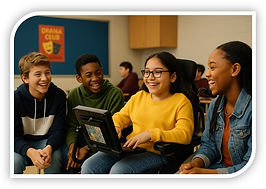
Aliyah is a creative and thoughtful Grade 8 student at Wayfinder Middle School. She uses a power wheelchair for mobility and a speech-generating AAC device to communicate. Although she enjoys school and is welcomed by peers, her relationships tend to stay surface-level. They are warm but distant. At lunch, she often eats beside her educational assistant, Ms. Nguyen, watching other students chat and joke in groups she’s rarely invited into. It’s not that others are unkind. They just don’t quite know how to connect.
Ms. Nguyen sees Aliyah’s longing for more. She notices how animated Aliyah becomes when storytelling or playing with dialogue on her device. When a poster for the school drama club goes up, a spark of possibility is lit. Could this be a path to deeper connection?
With support from the drama club’s teacher-sponsor, Ms. Nguyen helps make participation feasible and welcoming. Rehearsals are adapted, peer buddies are introduced, and opportunities to contribute both onstage and off are made visible. Aliyah begins writing scripts, suggesting costume ideas, and eventually delivering lines during a school production using her AAC.
What starts as a hopeful experiment becomes a turning point. Aliyah’s peers begin seeing her not only as capable, but as creative, funny, and deeply insightful. Lunchtimes shift from quiet solitude to lively group chats. A once-silent observer becomes a sought-out collaborator and friend. Her journey reminds the school community that belonging doesn’t just happen inside classrooms. It is built in the spaces where students share laughter, creativity, and purpose.

The Inclusion Advisory Board
Summit Grove Secondary School has a reputation for academic excellence and high achievement but underneath the surface, many students feel invisible or disconnected. The halls are marked by social cliques and silent hierarchies. Students with disabilities often sit alone at lunch. LGBTQ+ students speak of subtle exclusion. English Language Learners describe feeling present but not known. Despite the school’s many strengths, something vital is missing: a culture of true belonging.
Ms. Kaur, one of the vice principals, notices these patterns and begins to listen more closely. After a student shares in a hallway conversation that “school feels like a place where you perform, not belong,” she knows something needs to change. Rather than launching another staff-led initiative, Ms. Kaur proposes something different: a student-led Inclusion Advisory Board. She imagines a space where students themselves would identify gaps, elevate unheard voices, and lead cultural change.
What begins as a small council of five students quickly gains momentum. Through listening sessions, co-designed initiatives, and visible leadership, students begin reshaping the very fabric of school life. They reimagine spirit days, create mentorship programs, and introduce initiatives like “Ask Me About…” buttons to spark inclusive conversation. As students begin to take ownership, they also begin to model a new kind of school spirit. A spirit built on respect, connection, and courageous visibility.
By year’s end, the work of the Inclusion Advisory Board is no longer a project. It is a movement. It spreads to feeder schools, partners with community organizations, and changes the way Summit Grove defines success. This is not just about tolerance. It’s about transformation and it’s being led by the students themselves.

Connecting Through Culture
Logan is a quiet and observant Grade 5 student at Riverstone Elementary School. He keeps to himself most of the time, content to read during recess or sketch quietly at his desk. Teachers describe him as kind and bright but often invisible. Despite efforts like buddy systems and lunch clubs, Logan has struggled to form lasting peer connections. The social world of school seems distant, and his teachers are unsure how to draw him in without overwhelming him.
Ms. Cardinal, the division’s Indigenous support worker, sees something more. She notices how Logan lights up when they talk about his Métis heritage, and how his whole posture shifts when he’s beading or listening to fiddle music. She begins to wonder: What if Logan didn’t have to leave his culture at the classroom door? What if his identity became the bridge to belonging?
With Ms. Cardinal’s support, Logan is invited to help co-create a Métis storytelling display for the school’s cultural week. He’s hesitant at first but when another student named Evan joins him out of curiosity, something shifts. The two boys begin working together, sharing stories, experimenting with traditional crafts, and preparing a short presentation. Their collaboration becomes the starting point of deeper peer relationships and broader cultural inclusion across the school.
As Logan’s story unfolds, the classroom begins to shift. Cultural identity becomes a source of connection, not separation. Students begin to share their own traditions and stories. With guidance from Elders and the steady presence of Ms. Cardinal, Logan moves from the quiet corners of the school into its heart, not by changing who he is, but by being seen more fully. His story becomes a reminder that belonging is not something we give. It's something we co-create by honouring the stories that live within each student.

Quiet, But Present
Tessa is a thoughtful, observant Grade 4 student at Riverstone Elementary School. For over a year, she hasn’t spoken aloud at school. Not during class, not at recess, not even in small groups. Diagnosed with selective mutism, Tessa communicates freely at home but becomes completely silent in school environments. Her teachers care deeply but feel uncertain about how to build her confidence and connection. Peers are kind, but unsure how to engage. She often sits quietly in group settings, watching rather than participating. Present, but unseen.
What few people notice at first is that Tessa is a gifted artist. Her journals are full of vibrant drawings, clever captions, and expressive characters. Her written work reveals insight, humor, and emotional depth. One day, during independent writing, her teacher notices a quiet note passed between Tessa and a classmate named Amari. It’s not a disruption. It’s a beautifully drawn comic panel, co-created in silence. This quiet exchange sparks an idea: What if connection didn’t always need to be verbal? What if expression could take many forms?
From that moment, Tessa’s world begins to open. Her teacher introduces multimodal journaling, peer writing prompts, and silent collaborative art. Amari becomes a steady friend and creative partner, helping Tessa share her voice through pictures and stories. Slowly, the classroom begins to shift. Communication is no longer limited to words. It’s built through drawing, writing, gestures, and shared experiences.
Tessa’s story reveals a profound truth: that belonging doesn’t depend on speaking out loud. It grows when students are given space to express who they are in the ways that feel safest. Through inclusive expression, Tessa finds her place, not just as someone who is tolerated in silence, but as someone deeply known and cherished.

Small Shifts, Big Impact
Darren is a calm, observant educational assistant at Wayfinder Middle School who rarely draws attention to himself but his impact is deeply felt. Assigned to support students with a variety of access needs, Darren spends much of his day circulating between classrooms and common areas, checking in, coaching, and quietly guiding students through routines. Over time, he begins to notice something troubling: students with disabilities or social differences often sit alone at lunch. Some eat in silence, others scroll through their devices, and a few leave the cafeteria entirely. Although peers are rarely unkind, they’re often unsure of how to engage. Invisible barriers persist.
The pattern is familiar to Darren. He remembers what it felt like to be overlooked in his own middle school years. He was awkward, unsure of where to sit, often retreating to corners. He knows firsthand how isolating school can feel when you don’t quite fit the mold. One day, instead of watching from the sidelines, Darren takes his lunch tray and sits down with a group of students who often sit alone. He doesn’t make a speech or force interaction. He just pulls up a chair and starts a casual conversation. The next day, he does it again. And then again.
What starts as a quiet gesture soon ripples outward. Darren suggests rotating peer lunch tables with simple prompts to help students connect. He collaborates with teachers to rework group projects so every student, regardless of support needs, can meaningfully contribute. He begins mentoring a small group of peer supporters, coaching them on how to include others intentionally and respectfully. Slowly, the culture begins to shift. Lunchtime grows louder, more joyful, and more mixed. Students stop seeing “those kids” and start seeing their classmates.
Darren’s story reminds us that inclusion isn’t always built through grand programs or sweeping reforms. Sometimes, it starts with a tray, a question, and a willingness to sit beside someone who’s been left out. Through everyday interactions, Darren helps change the social fabric of Wayfinder, from the margins inward.
© 2025 by The Belonging Project. Website created with Wix.com